What Do Jewels Do in a Watch? 17, 21, 24 and 25 Jewels Explained

FIYTA FIYTA

Nov 08, 2026

Quick Answer: Watch jewels are tiny, usually synthetic ruby components placed at selected contact points inside a watch movement. They provide durable bearing surfaces or perform specialized jobs within the escapement, helping control friction and reduce wear. A movement marked "21 Jewels" contains 21 jewel components, but the count is not a universal quality score. A well-designed 17-jewel movement can perform its intended job properly, while a 25-jewel movement is not automatically more accurate. What matters is where the jewels are used and how the entire movement is engineered.
Close-up of a traditional 17-jewel mechanical watch movement showing ruby jewel bearings and metal components
A traditional 17-jewel mechanical watch movement. Photo by CEphoto, Uwe Aranas. Image source and CC BY-SA 3.0 license. Unmodified image.

Turn over a mechanical watch with a transparent case back, and you may notice several tiny red or pink circles scattered among its bridges, gears and screws. Some movements also have the words "21 Jewels", "24 Jewels" or "25 Jewels" engraved on a rotor or plate.

It is easy to assume those numbers indicate quality. After all, gemstones are valuable, and more usually sounds better. A watch with 25 jewels must surely be more sophisticated than one with 17, right?

Not necessarily. The tiny red components are not there to make the watch look expensive. They perform specific mechanical jobs, and the total number tells us considerably more about the movement's construction than about luxury or prestige.

Understanding watch jewels reveals something interesting about mechanical timekeeping. Some of the parts that help a movement remain reliable are almost invisible, even when the movement is displayed through an open case back.

What Are Jewels in a Watch Movement?

Watch jewels are small, extremely hard components used at selected bearing and contact points inside a timekeeping movement. In modern production, they are usually made from synthetic ruby, a laboratory-produced form of corundum. Synthetic sapphire belongs to the same mineral family, although its appearance and particular uses may differ.

These are real crystalline materials with useful physical properties, not red plastic decorations. Their value in watchmaking comes primarily from hardness, resistance to wear, the quality of their finished surfaces and the precision with which they can be manufactured.

The word "jewel" can therefore be misleading. You are not buying a collection of precious gemstones hidden inside a wristwatch. You are looking at miniature precision components designed to interact with metal pivots and other moving parts.

Why Are Synthetic Rubies Used?

A useful comparison is a bearing in a wheel, although the construction inside a watch is much smaller and more delicate. A bearing supports a moving component while helping control friction and wear. In a watch movement, some jeweled bearings support extremely fine metal shafts, whose ends are called pivots.

Those pivots need to remain properly positioned as the movement operates. If their supporting surfaces wear excessively, the geometry of the mechanism can change and its performance may suffer.

Synthetic ruby offers a durable surface that can be made with tiny, precisely shaped openings and carefully finished contact areas. Its material consistency also makes it practical for modern manufacturing.

Historically, natural gemstones were used in some timepieces. The development of synthetic materials made it possible to produce jeweled components much more consistently and economically.

Are Watch Jewels Real Gems?

They are genuine crystalline corundum when made from synthetic ruby, but they should not be confused with jewelry-grade stones valued for rarity, size or beauty. A jewel bearing may be only a tiny ring or disk, made to precise dimensions rather than cut for decorative display.

The same basic material can also appear in very different shapes. Some jewels are ring-like bearings with a central hole. Others are flat endstones, angular pallet stones or small projections associated with the escapement.

The distinction between useful mechanical components and decorative jewels matters enough to have its own technical standard. ISO 1112:2009 defines functional and non-functional horological jewels and addresses their description in movement markings and advertising.

It does not create a universal watch-quality rating based on jewel count. Its relevance is the function of the jewels, not the assumption that the largest number wins.

Why Do Mechanical Watches Need Jewels?

A mechanical watch is constantly moving, even when it appears perfectly still on your wrist. Its mainspring releases stored energy through the gear train, while the escapement and balance regulate how that energy is delivered.

Many of those moving components turn on small pivots. The supporting surfaces experience repeated contact through thousands of hours of operation. Without appropriate materials and lubrication, wear at those points could gradually affect movement geometry and performance.

Jewels provide hard, stable contact surfaces that help manage this problem. Their job is not to make the mechanism frictionless, but to provide suitable bearing or working surfaces where precision and repeated contact matter.

How a Ruby Bearing Supports a Steel Pivot

Cross-section showing a steel watch pivot passing through a ruby hole jewel beneath a cap jewel with lubricating oil
Sectional illustration of a watch pivot, hole jewel, cap jewel and lubricant. Diagram by Chetvorno, public domain. Original illustration and license details.

Imagine a very fine steel pivot turning inside a small hole. The pivot needs enough clearance to move, but not so much that the connected wheel can shift unnecessarily. Its supporting surface also needs to maintain its shape over repeated cycles.

A carefully finished ruby bearing can serve that role. Its hardness helps resist wear, and the bearing opening can be manufactured to a very precise geometry. In many designs, a small quantity of appropriate lubricant further controls the contact between the metal pivot and the jewel surface.

This is why the statement "jewels eliminate friction" is incorrect. The system still involves contact, movement, loads and lubrication. The bearing material contributes to good performance, but it does not remove the laws of mechanics.

Why Not Put Jewels Everywhere?

Different components have different operating requirements. A rapidly oscillating balance pivot, a slower wheel arbor and a winding component do not necessarily benefit from the same bearing design.

Some movement parts work perfectly well with different bearing materials. Others need specific jewel shapes to handle their loads or to interact with the escapement.

Adding a jewel without a useful mechanical role does not automatically improve the movement. A simpler construction may be entirely appropriate when a particular component does not require a jeweled bearing.

Jewels also do not create or store energy. That is the mainspring's job. For a broader explanation of stored energy and runtime, our guide to automatic watch power reserve explains how a mechanical movement continues operating between windings.

The jewels help particular parts of that energy-transmission system operate with controlled contact and wear. They are important, but they are only one part of the engineering.

Four Common Types of Watch Jewels and What They Do

Not all watch jewels resemble little red rings. Some are bearings, some provide axial support, and others participate directly in the escapement. Understanding those differences explains why a movement may have an odd jewel count and why not every jewel can be seen through the back of the watch.

Hole Jewel A precisely shaped opening provides bearing support for a pivot.
Cap Jewel / Endstone A contact surface helps control axial movement at the end of a pivot.
Pallet Jewel A shaped stone interacts with escape-wheel teeth in a lever escapement.
Impulse / Roller Jewel A small component helps transfer impulses between the pallet fork and balance assembly.

Hole Jewels and Cap Jewels

A hole jewel contains a precisely formed opening through which a pivot passes. It provides bearing support and helps keep the arbor in the correct position.

The hole jewel is especially important for controlling radial movement, meaning motion sideways relative to the pivot's axis. It does not necessarily provide all the axial support that a particular pivot needs.

A cap jewel, also called an endstone, is usually a small flat bearing surface positioned at the end of a pivot. It provides a contact surface that can help control movement along the axis.

In certain balance-bearing assemblies, hole jewels and cap jewels work together. This matters because wristwatches change orientation constantly. A watch may rest dial-up on a desk, hang vertically on the wrist, or rotate between positions during the day.

Those changes affect how mechanical loads act on small pivots. Suitable bearing geometry helps the movement operate across different orientations. Some designs also incorporate shock-protection settings and springs, which allow controlled movement during an impact.

The jewel is only one element of such an assembly. The setting, spring and pivot geometry also matter. It would be misleading to say that the ruby alone provides complete shock protection.

Pallet Jewels and Impulse Jewels
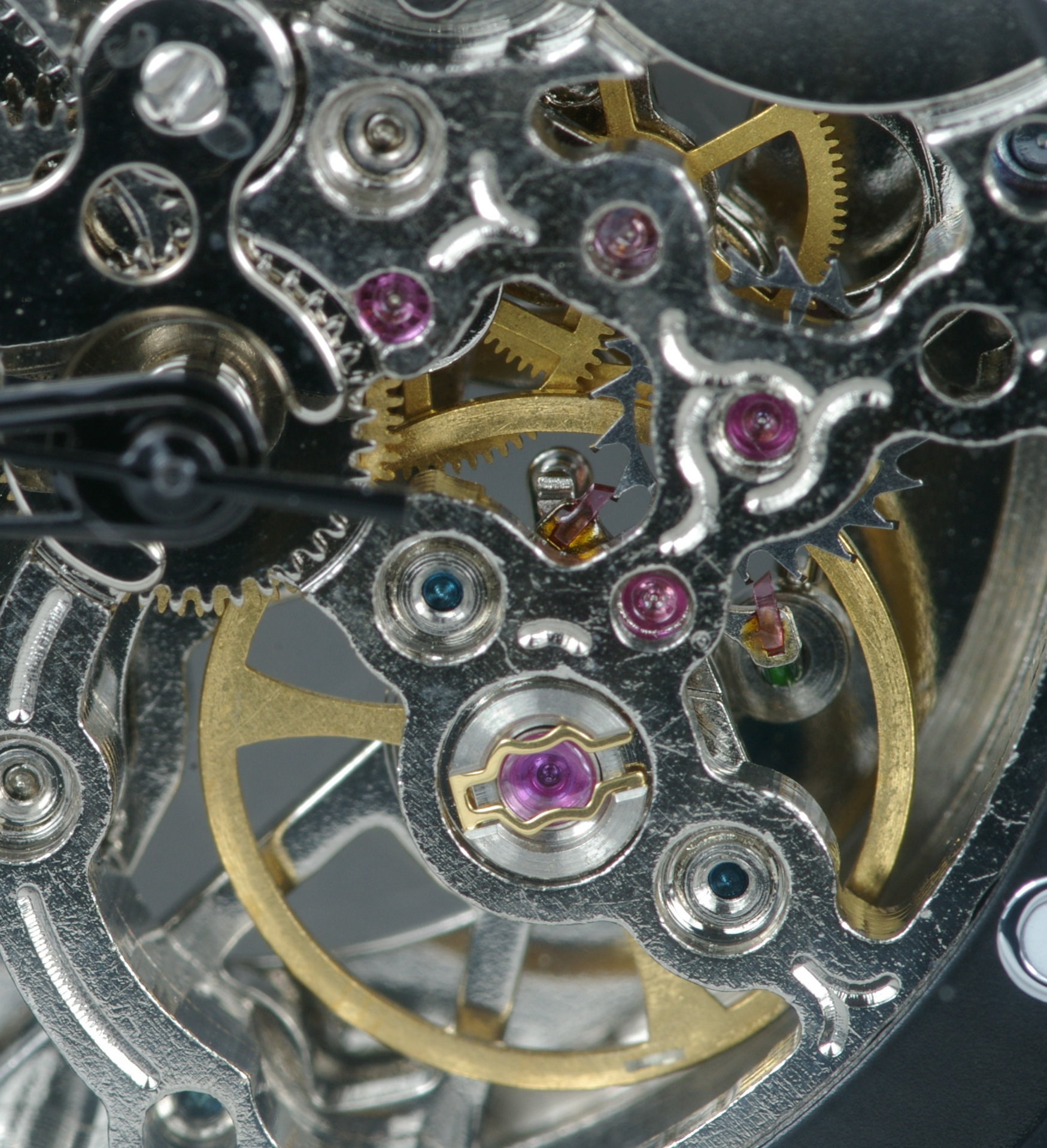
Macro photograph showing the balance wheel pallet fork escape wheel and ruby jewels of a mechanical watch movement
A view of the balance, pallet fork and escapement in a Chinese TY2807 movement. Photo by Hustvedt. Image source and CC BY-SA 3.0 license. Unmodified image.

Some of the most important watch jewels are not pivot bearings at all. In a conventional Swiss lever escapement, two pallet jewels are mounted at the working ends of the pallet fork.

These jewels interact with the teeth of the escape wheel as the escapement locks, unlocks and transfers energy. Their shape and positioning are critical to how the mechanism operates.

An impulse jewel, also called a roller jewel, is associated with the balance assembly. It interacts with the pallet fork to help transmit impulses to the balance.

Unlike a typical hole jewel, the impulse jewel is not a ring around a rotating steel pivot. It has its own geometry and specific mechanical purpose.

This also helps explain why watch jewel counts are often odd numbers. Not every jewel appears as one half of a pair. A conventional lever escapement contains a single impulse jewel.

Different escapement designs can use different components and arrangements. These four categories describe common traditional functions, not every possible jewel used in all modern horology.

What Do 17, 21, 24 and 25 Jewels Mean on a Watch?

The number engraved on a movement is a description of its jewel components, not a direct statement about accuracy, finishing or value. Its significance becomes much clearer when connected to a real movement and the jobs its components perform.

What Does 17 Jewels Mean?

Seventeen jewels is a familiar figure in traditional mechanical watchmaking. One conventional 17-jewel lever movement places jewels at important gear-train bearings, the balance bearings, the pallet-fork pivots and the working components of the escapement.

The exact arrangement may vary, but a classic example can be explained as follows:

Location Number Function
Balance hole jewels 2 Radial support for balance pivots
Balance cap jewels 2 End support for balance pivots
Pallet-fork pivot jewels 2 Support the pallet-fork arbor
Pallet stones 2 Contact the escape-wheel teeth
Impulse / roller jewel 1 Transfers impulses to the balance
Center-wheel bearings 2 Support the center-wheel arbor
Third-wheel bearings 2 Support the third-wheel arbor
Fourth-wheel bearings 2 Support the fourth-wheel arbor
Escape-wheel bearings 2 Support the escape-wheel arbor
Total 17 Illustrative traditional layout

This arrangement follows a traditional lever-watch construction described in historical horological teaching. It is not a mandatory arrangement for every movement marked 17 jewels. Manufacturers can distribute jewels differently according to their designs.

Seventeen is also not a universal minimum for a good movement. The British Horological Institute describes traditional fully jeweled constructions with at least 15 jewels in appropriate layouts.

A properly designed 17-jewel movement can therefore be entirely suitable for its intended purpose. Its actual quality depends on far more than the number engraved on a bridge.

What Does 21 Jewels Mean?

Twenty-one jewels is another common figure, especially among automatic movements. The Miyota 8215 is a useful modern example because its specifications are published directly by the manufacturer.

The Miyota 8215 has 21 jewels, a frequency of 21,600 vibrations per hour and an approximately 42-hour running time. Its current official specifications also list manual winding and a stop-second device.

Those details tell us more about the movement than the count alone. They describe how the movement operates and what features are available to the wearer.

The figure 21 does not mean that every 21-jewel movement shares the same architecture. Different manufacturers may place additional jewels in different mechanisms.

Without the actual movement documentation, it would be unjustified to say that the four-jewel difference between a particular 17-jewel movement and the Miyota 8215 comes from one universal arrangement.

What About 24 and 25 Jewels?

The Miyota 9015 uses 24 jewels. Its official specifications also list a frequency of 28,800 vibrations per hour, an approximately 42-hour running time, and a movement height of 3.90 mm.

The 8215, by comparison, operates at 21,600 vibrations per hour and has a height of 5.67 mm.

That difference involves movement architecture, dimensions and frequency, not merely three extra jewel components.

Seiko provides another useful comparison. The 4R35 has 23 jewels and a date display. The closely related 4R36 has 24 jewels and displays both the date and day of the week.

Both are rated at 21,600 vibrations per hour, with approximately 41 hours of power reserve.

The ETA 2824-2 gives us a familiar 25-jewel example. It operates at 28,800 vibrations per hour and has a typical power reserve of approximately 42 hours.

Movement Jewels Frequency Power Reserve
Traditional hand-wound example 17 Varies Varies
Miyota 8215 21 21,600 vph Approx. 42 h
Seiko 4R35 23 21,600 vph Approx. 41 h
Seiko 4R36 24 21,600 vph Approx. 41 h
Miyota 9015 24 28,800 vph Approx. 42 h
ETA 2824-2 25 28,800 vph Typical 42 h

These figures come from the published specifications of Miyota, Seiko and ETA. The traditional 17-jewel row is an illustrative construction, not a particular modern caliber.

Look closely at the comparison. Two 24-jewel movements can have different frequencies and architectures. Movements with different jewel counts can also have similar running times.

The numbers describe separate engineering characteristics. They do not form a ranking from worst to best.

Does Having More Jewels Make a Watch Better or More Accurate?

More jewels can be useful when the movement's construction genuinely needs them. Beyond that, the count is a poor shortcut for judging quality.

Imagine two movements, one with 21 jewels and another with 25. The additional components may support a different winding system, another mechanical function, or a different bearing arrangement.

Those additions could be useful for that specific architecture. They do not automatically mean that the balance is better regulated, the components are made to tighter tolerances, or the finished watch keeps more accurate time.

Jewel Count and Accuracy Are Different Specifications

A mechanical movement's rate depends on its regulating system and operating condition. Factors can include balance behavior, escapement geometry, adjustment, positional variation, temperature, magnetism, winding state and wear.

The jewel count provides very little direct information about how those variables have been controlled.

For example, Seiko lists the 23-jewel 4R35 and the 24-jewel 4R36 with the same factory-adjusted daily accuracy specification: +45 to -35 seconds under the stated conditions.

That does not guarantee identical performance on every wrist. Seiko explicitly notes that actual rate can vary with wearing conditions, temperature, movement and the state of the mainspring.

What it does demonstrate is that a movement with one extra jewel does not automatically receive a better published accuracy category.

Miyota's 8215 and 9015 have different published accuracy tolerances, but they also differ in frequency, thickness and overall construction. It would be misleading to claim that additional jewels directly caused the entire difference.

What About Durability and Quality?

Properly positioned jewels can help reduce wear in important locations. But long-term durability also depends on lubrication, assembly quality, materials, sealing, maintenance and the stresses experienced by the watch.

Similarly, a movement with many jeweled components may be legitimately complex, while a simpler design may need fewer.

The question is whether each jewel serves a real mechanical purpose. An excessive count without a corresponding functional reason should not be treated as a prestige feature.

If you are comparing watches for practical timekeeping, look at the exact movement's published tolerance and the behavior of the finished watch. Our guide to automatic watches running fast or slow explains why average rate, consistency and sudden changes matter more than a single jewel-count figure.

Do Quartz Watches Have Jewels Too?

Yes. Some quartz watch movements contain jewels, even though they regulate time electronically instead of using a conventional mechanical balance and lever escapement.

An analog quartz watch still contains moving mechanical parts. Its motor and gear train position the hands, and some designs use jewelled bearings at selected contact points.

For example, the ETA E01.701 is a quartz movement with five jewels, according to ETA's official specifications.

That does not mean every quartz movement has five jewels. The number depends on the particular construction. Some quartz movements use fewer, more or no jewel bearings at all.

It is also important not to confuse two very different components: the quartz crystal that provides the timing reference and a synthetic ruby jewel that acts as a mechanical bearing.

They perform different jobs. A jewel-bearing count does not turn a quartz movement into a traditional mechanical watch.

This is one reason the 21-jewel specification of an automatic movement cannot be directly compared with the five jewels of a quartz caliber. The two mechanisms have different architectures and operating requirements.

For the broader difference between their timekeeping systems, read our mechanical versus quartz watch movement guide.

Do Watch Jewels Wear Out or Need Lubrication?

Synthetic ruby is hard and highly resistant to wear, but a jeweled movement is not maintenance-free.

The bearing system also includes metal pivots, closely controlled clearances, other movement components and lubricants chosen for specific conditions.

In many bearing arrangements, a small quantity of lubricant is applied where a pivot interacts with a jewel. Its job is to help control friction and wear.

The material's hardness does not eliminate the need for suitable lubrication. The lubricant and the geometry of the bearing are part of the complete system.

Why Lubrication Still Matters

Watch movements operate with extremely small components and carefully controlled amounts of oil.

Using too much lubricant can be as undesirable as using too little. Oil may spread away from the intended contact area, contaminate nearby components or alter the behavior of a mechanism.

Lubricants can also deteriorate, migrate or become contaminated over time. Their performance depends on their formulation, application and the movement's operating conditions.

That is why a watch may require professional inspection or service despite using jeweled bearings in critical locations.

Can the Jewels Themselves Be Damaged?

Yes. High hardness does not mean that a material is impossible to chip or fracture.

A severe impact, improper handling or incorrect service procedure can damage a jewel or its surrounding assembly.

The metal pivot can also become worn or damaged even if its ruby bearing remains intact. The health of the movement depends on the complete contact system, not on the jewel alone.

A watch that loses accuracy, develops a shorter power reserve or behaves unpredictably may have a lubrication-related problem, but many other causes are possible.

Magnetism, impact, regulation, winding issues and damage elsewhere in the movement can produce similar symptoms.

Why You Should Not Oil a Movement Yourself

Servicing a movement involves far more than adding a drop of oil. A proper service may include inspection, disassembly, cleaning, component evaluation, lubrication, reassembly, regulation and testing.

Opening a watch without the correct tools and working conditions can introduce dirt, damage delicate parts or compromise water resistance.

There is also no single maintenance interval that applies to every mechanical watch. The exact movement, its use, age, condition and manufacturer guidance all affect the decision.

For ordinary ownership, follow the automatic watch maintenance guide. If the movement's behavior changes significantly, our article on when to service a luxury watch explains how to approach professional assessment.

The practical lesson is simple: jeweled bearings help control wear, but they are only one part of a larger mechanical system that still requires appropriate care.

How Much Should Jewel Count Matter When Buying a Watch?

Jewel count is useful technical information, but it belongs alongside other movement specifications, not above them.

If two watches have different jewel counts, start by identifying their exact calibers. Without that information, the numbers reveal surprisingly little.

A manufacturer's technical sheet may tell you about frequency, accuracy, power reserve, movement dimensions, winding capability, calendar functions and servicing.

Those details help explain how the movement is designed and whether its characteristics fit the way you intend to use the watch.

What Should You Check Before Buying?

Specification Why It Matters
Exact movement caliber Identifies the design being evaluated
Jewel count Describes part of its bearing and escapement construction
Published accuracy range Provides the manufacturer's intended timing tolerance
Power reserve Describes approximate runtime from a suitable winding state
Winding and stop-seconds functions Affects everyday setting and operation
Servicing and parts support Influences long-term ownership

A buyer interested in a thinner automatic watch might place more value on movement height than on the difference between 21 and 24 jewels. Someone who rotates several watches may care more about power reserve. Another buyer may prioritize published accuracy or service availability.

The jewel count can help describe the movement, but it cannot decide these priorities for you.

Why the Exact FIYTA Model Matters

At FIYTA, we believe it is more useful to explain the actual movement than to treat a single technical number as a marketing shortcut.

FIYTA watches use different movement configurations across the product range. Some models have publicly documented movement details, while others are described more generally as using an automatic mechanical movement.

That distinction is especially important when discussing jewel count.

If the exact movement inside a watch has not been confirmed, it would be misleading to assign it the jewel count of a superficially similar model or a third-party movement assumed to be inside.

For a broader explanation of different calibers and available specifications, see our guide to FIYTA watch movements.

The same principle applies to any watch brand. When a retailer describes a watch as having 25 jewels, it is sensible to ask which movement supplies that specification.

Are the Jewels Valuable?

The tiny synthetic rubies used in modern movements are not usually a major source of a watch's retail value as gemstones.

The cost of an entire watch depends on factors such as engineering, component manufacturing, assembly, finishing, materials, quality control, distribution and after-sales support.

A movement with 25 jewels should therefore not be assumed to contain more precious gemstone value than one with 17 in a way that makes the finished watch a better investment.

Can You Count All the Jewels Through a Case Back?

Usually not. Some jewel bearings are visible on the movement bridges, but others may be hidden beneath components, on the dial side or inside mechanisms that cannot be seen without disassembly.

The visible red circles are not a reliable inventory of every jewel inside the movement.

A complete count is better verified through the manufacturer's technical documentation rather than through a photograph.

For those considering their first mechanical watch, our guide to choosing a FIYTA automatic watch explains the wider ownership decision, including movement type, fit, intended use and daily practicality.

Final Thoughts: The Right Jewels Matter More Than the Number

The tiny red components inside a watch do important work. They help support moving pivots, control wear and perform key functions in the escapement.

But the number printed on a movement should never be mistaken for a universal quality score.

A 17-jewel movement is not automatically inferior to a 21-jewel design, and a 25-jewel movement is not guaranteed to outperform one with 24.

Different movements use different architectures, parts and engineering priorities.

If you want to understand what the jewels in a particular watch actually tell you, begin with the exact movement and the functions those jewels perform. Then consider the movement's accuracy, reliability, maintenance and how well it suits your needs.

The most useful question is not simply how many jewels a watch contains. It is whether those jewels are doing the right jobs in a well-designed movement.


Watch guides

Applied vs Printed Watch Indices: What Makes a Dial Better?

At a Glance Applied indices are separate hour markers attached to a watch dial, while printed indices are markings deposited onto its surface. Applied markers often add depth and changing reflections; printed markers can deliver precise detail, strong contrast and a cleaner appearance. Raised printing complicates the distinction because a marker can look three-dimensional without being a separate component. Neither method automatically produces a better watch. Dial quality depends on construction, alignment, readability, surface finishing and how the entire design works together. A watch dial can look surprisingly different when you move it just a few degrees. A polished hour marker catches the light, then nearly disappears against the background. A printed numeral remains clear from one angle but becomes harder to distinguish when the crystal reflects a window overhead. These small details shape the experience of reading a watch dozens of times a day. When comparing watches, buyers often encounter two terms: applied indices and printed indices. The first sounds more elaborate, while the second can sound inexpensive. That impression is understandable, but it misses how much design and manufacturing work can go into either approach. The interesting question is not which method sounds more premium. It is how the constructions affect the dial, how to distinguish them, and how to recognize a well-executed result. Close-up of a FIYTA women's automatic watch. The raised markers and changing reflections illustrate why dial details must be judged under real light, not only from straight-on photographs. In This Guide Applied vs. Printed Indices How Indices Are Made Which Is Easier to Read? Lume, Colors and Textures Durability and Workmanship Why Expensive Watches Use Printing How to Judge Dial Quality What Are Applied and Printed Watch Indices? Watch indices are the marks that help identify positions around the dial, most commonly the hours. They may appear as slender batons, dots, triangles, Arabic numerals, Roman numerals or more unusual shapes. Not every watch uses twelve hour markers, and some minimalist designs omit several or all of them. Nevertheless, the indices often provide the visual framework that makes the hands easy to interpret. An applied index is a separate physical element attached to the dial. It generally rises above the underlying surface, creating depth that can be noticeable even before examining the watch closely. Metal is common, but the precise material and construction vary. Some applied markers have polished facets; others are brushed, coated or filled with luminous material. Their appearance depends as much on finishing and geometry as on the fact that they are attached components. Printed indices are created by applying markings directly to the dial surface. The design might consist of numerals, short hour lines, minute tracks or combinations of those elements. Printing is especially useful when a dial requires fine detail, closely spaced information or a deliberately restrained appearance. A printed marker can be a simple line, but it can also be a carefully shaped graphic with consistent edges and controlled proportions. The distinction concerns construction rather than the importance of the information displayed. A tiny printed minute index can be just as essential for accurate reading as a large applied hour marker. Likewise, a prominent metal baton may look appealing without necessarily improving the ability to read the time. Consider a classic three-hand watch. Its hour markers must work with the hands, dial color, crystal and case proportions. A narrow polished index may provide attractive reflections, but if it repeatedly blends into a glossy dial, its visual sophistication may not translate into better legibility. A white printed index on a dark matte surface may create less visual drama while remaining easy to read. Applied and printed elements can coexist on the same dial. A watch might use raised metal hour markers, printed minute marks and a printed brand name. Another design might combine printed numerals with a separate emblem or decorative component. There is no rule requiring the entire dial to use one construction method. A further complication is that a marker's apparent height does not always reveal how it was manufactured. Multiple layers of printing can produce noticeable relief, while some dial features are formed from the base material rather than individually attached. That is why a close-up photograph can suggest how a dial was made but cannot always prove it. The distinction becomes more meaningful once the manufacturing processes are examined. It also helps explain why a watch with relatively simple printed indices can be carefully executed, while one with elaborate applied markers still deserves inspection. How Are Watch Indices Made—and Can Printed Markers Be Raised? The difference between applied and printed indices becomes clearer when you consider what happens before the completed dial reaches the watch case. For applied markers, individual components must first be manufactured. Their shapes may be formed through processes suited to the material and design, followed by finishing, coating or other treatments. An index may have straight sides and a polished upper surface, or it may include multiple facets that catch light from different directions. The marker then has to be positioned accurately on the dial. Some designs use small feet that fit into prepared holes, with the attachment secured from the rear. Other constructions use suitable bonding methods. The specific approach depends on the manufacturer, dial structure and component design. This assembly creates a quality-control challenge. Hour markers must sit consistently around the dial. Their angles, spacing and visual alignment should work together, especially when the design relies on repeated shapes. A small deviation can become noticeable when twelve similar markers create a strong geometric pattern. Printed indices follow a different production sequence. Pad printing is one established method for transferring fine markings onto watch dials. In simplified terms, the graphic is prepared on a printing plate, ink is transferred to a flexible pad, and the pad deposits the design onto the dial surface. The process can reproduce delicate lettering, tracks and markings with considerable control. The apparent simplicity of a printed line should not obscure its manufacturing requirements. Ink behavior, alignment, surface preparation and repeatability influence the result. Fine details can be challenging on complex textures, curved surfaces or designs requiring several colors. A printed dial may also require multiple passes for different elements. The brand name, hour numerals, minute track and other information do not necessarily come from one application. Then there is raised printing. A marker that rises above the dial surface is not necessarily an applied component. Its relief may come from a separately manufactured index, successive layers of printing, or a feature formed in the dial material itself. These approaches can produce similar shadows in photographs, even though their manufacturing processes are different. Terms such as up-print describe printing techniques that build noticeable relief. From a normal viewing distance, raised printing may resemble an applied marker, particularly when photographed under directional lighting. Stamped or otherwise formed details introduce another possibility. A feature can appear raised because the dial material has been shaped, rather than because another component was attached afterward. The useful distinction, therefore, is not simply flat versus raised. It is whether the marker is a separate element attached to the dial or part of the graphic or formed surface. Unless the manufacturer identifies the construction, visible depth should be treated as an observation rather than proof of a particular technique. This becomes especially important when comparing watches from online product photographs. Understanding the processes also changes how craftsmanship can be evaluated. Instead of assuming that greater height automatically means better quality, we can appreciate the different challenges involved in precise placement, consistent printing and controlled finishing. Do Applied Indices Make a Watch Easier to Read? At first glance, applied indices seem to have an advantage: they stand above the dial and can catch light along their edges. That additional depth may help distinguish them from the background. It may also make the watch appear more dynamic as the viewing angle changes. But legibility is not determined by depth alone. Reading a watch depends on how easily the eye separates the hands and markers from their surroundings. Contrast is particularly important. A bright marker against a dark background can be immediately recognizable, while a dark marker on a similarly colored dial may require closer attention. Polished applied markers introduce an interesting complication because their appearance changes with reflected light. A facet may appear brilliant silver under one condition and almost black under another. On a reflective dial, the marker can sometimes blend into its surroundings rather than standing apart. This is not necessarily a defect. It is part of the visual character that makes polished markers attractive. It does explain why a beautiful product photograph cannot establish that a dial will be equally easy to read in every environment. Printed markers can offer a different kind of visual consistency. White markings on a dark matte dial, for example, may provide clear contrast across many viewing angles. They may lack the changing reflections of polished metal, but their simplicity can support quick recognition. Printing is also useful for detailed scales. A narrow minute track or densely spaced timing markers can be difficult to reproduce with separate components without adding unnecessary visual bulk. Fine printing lets designers provide information while preserving a clear hierarchy. Yet printed markers are not automatically clearer. Thin graphics may disappear against a busy background. Small numerals can become difficult to distinguish at a glance, and poorly chosen colors can reduce contrast even when the printing itself is precise. The hands must also be considered. A dial with excellent hour markers can still be difficult to read when the hands are too narrow, too short or insufficiently distinct from the background. Strongly contrasting hands can improve readability even when the dial uses relatively subtle markers. The crystal introduces another variable. Reflections from windows, lighting or the sky can obscure part of the dial regardless of index construction. This is one reason that the choice of watch crystal and its properties belongs in the wider conversation about visibility. For everyday use, the most revealing test is straightforward: examine the watch under several realistic lighting conditions instead of judging it solely under bright retail illumination. A marker that appears crisp in a studio photograph may behave differently near a window, beneath artificial office lighting or outdoors. The most successful dial is one whose hands, markings, surface and crystal work together to make the time easy to recognize. How Do Indices Work With Lume, Dial Colors and Textures? The construction of an hour marker is only one part of its appearance. The surface beneath it and the materials applied to it can dramatically change how the complete watch looks and functions. Luminous material provides one example. Some applied indices incorporate luminous inserts or coatings. A metal structure may frame a luminous area, allowing the marker to combine decorative finishing with nighttime visibility. Other markers use a simple geometry designed primarily for clear daylight reading. Printed markings can also incorporate luminous material, depending on the process used. The presence of lume therefore does not establish whether an index is printed or applied. This matters because buyers sometimes assume that a raised metal marker must provide better nighttime performance. In reality, an applied marker without luminous material may be difficult to see in darkness, while a well-designed luminous marking made through another process may be more useful. Nighttime readability depends on the hands and markers as a complete arrangement. Their shape, placement and luminous treatment matter alongside viewing conditions. The long-term behavior of luminous materials is a separate topic from the construction of indices. Dial color affects the result just as strongly. Dark matte surfaces often provide a useful background for lighter markings. Glossy black, deep blue and highly polished dials can create a reflective environment that changes the appearance of metal markers as the watch moves. Sunburst finishing adds directional reflections. An applied marker may create attractive highlights on such a dial, but those same reflections can sometimes compete with the hands. Textured surfaces introduce another consideration. A patterned dial may contain shadows, variations in color or visual detail that reduce the distinction between a marker and its surroundings. FIYTA women's wristwatch in an everyday setting. Mother-of-pearl and decorative hour markings show why surface, design and lighting need to be considered together. This image is not evidence of a particular index manufacturing process. Mother-of-pearl is a particularly interesting example because its appearance changes with light and viewing angle. Applied markers can create a physical layer above that surface, but actual readability still depends on marker color, shape and finishing. The FIYTA Serene Automatic women's watch, reference DLA24007.WWWD, provides a useful brand example. Its product description identifies applied hour markers on a mother-of-pearl dial. That description supports discussion of the visual design, though it does not independently establish the particular method used to attach those markers. White, cream and other light-colored dials create different challenges. Dark printed indices may offer strong separation, while polished metal markers can look elegant but become less distinct when their reflections resemble the background. There is no universally best combination. A practical outdoor watch, an elegant dress watch and a decorative women's watch may prioritize different experiences. Good dial design balances those goals rather than treating index construction as a stand-alone solution. Are Applied Indices More Durable or Better Made? Durability is another area where the difference between applied and printed indices is frequently oversimplified. Because applied markers are physical components, buyers may assume they must be more substantial and therefore more durable. Printed markers can appear vulnerable because their design is deposited on the dial surface. Neither assumption is reliable without considering the materials, attachment methods and manufacturing quality involved. An applied marker must remain securely attached throughout the watch's intended life. Its attachment may depend on accurately formed feet, a suitable mechanical connection, bonding materials or another method appropriate to the design. If an index is improperly installed or subjected to significant shock, it may become loose. That possibility does not mean applied markers are generally unreliable. It means their construction introduces attachment interfaces that must be executed correctly. Printed indices have different requirements. Their longevity depends partly on the compatibility between the marking material, prepared dial surface and any protective finish. Application quality and environmental exposure can influence how the printing ages. High-quality printing should not be presumed fragile simply because it is not a separate component. Printed markings have a long history in watchmaking, including on designs intended for practical everyday use. Similarly, a thick applied marker should not be assumed immune to cosmetic damage. Polished surfaces can become scratched, coatings may deteriorate under unsuitable conditions, and external shocks may affect components beyond the dial. The durability of indices must also be distinguished from the durability of the complete watch. Water resistance, impact protection, case construction and movement reliability are separate considerations. Manufacturing quality can sometimes be assessed visually, although photographs are less reliable than direct inspection. Applied indices should appear consistently positioned within the intended design. A noticeably tilted marker or unexpected gap may justify closer examination, provided the appearance is not caused by perspective or deliberate styling. Printed markings should have edges and proportions appropriate to the design. Obvious misregistration between layers, irregular shapes or smudging may indicate a problem with execution. These observations require restraint. Macro photography can exaggerate tiny details, while reflections create apparent misalignment. A single photograph is often insufficient to establish a defect. Nor should deliberate decorative effects be confused with poor workmanship. Certain textured or distressed dials incorporate irregularity as part of their visual design. There is no reliable universal service-life figure for all printed or applied markers. Their actual longevity depends on construction, environment and how the watch is treated. The most useful maintenance distinction is that internal dial components are not ordinary cleaning surfaces. Owners should not open a watch to wipe a marker or attempt to reattach a loose index. Our guide to cleaning a luxury watch safely addresses the boundaries of routine exterior care. For buyers, consistency, documented quality and suitable support are more meaningful than an assumption that one category of index will always last longer. Why Do Some Expensive Watches Use Printed Indices? A familiar question arises when someone sees an expensive watch with printed hour markers: why does it not use applied indices? The question assumes that raised components are inherently more luxurious, while printing is merely a cost-saving alternative. Sometimes applied markers require additional component manufacturing and assembly, but that does not automatically make printing a lesser design choice. A dial exists to communicate information while expressing a particular visual identity. Different watches solve that challenge in different ways. Consider a timing-oriented design that requires many small markings. Precise printed scales can provide dense information without adding individual raised parts at every position. This helps preserve a hierarchy between major hour markers, minute divisions and additional indications. On a restrained dress watch, printing can contribute to a flat and balanced surface. Fine numerals and delicate tracks may create an appearance that would change considerably if the designer substituted thicker metal components. Historical design language also influences the choice. Some watches deliberately retain printed numerals, railway-style minute tracks or graphic elements associated with earlier instruments. Replacing those markings with applied shapes could change the character that makes the design appealing. A higher price does not imply that every visible feature must use the most three-dimensional construction available. Dial manufacturing also involves processes that are not immediately apparent. Accurate printing, preparation of the surface, careful registration and consistent application of several graphical layers require control and skill. Those qualities may be less dramatic in a photograph than polished applied batons, but they remain part of the finished result. Applied markers offer a different visual language. They introduce physical depth, directional reflections and a sense of architecture. On some watches, that is exactly what the design needs. On others, the same effect might add unnecessary visual weight. The appropriate choice depends on the relationship between the indices, hands, surface and overall character of the watch. Buyers should therefore resist treating applied indices as a mandatory feature at any particular price. A watch can have exceptionally well-executed printed graphics without looking inexpensive, just as a watch can have polished applied markers without being especially accurate or mechanically sophisticated. Price may reflect movement construction, case materials, manufacturing methods, finishing, production scale, brand positioning and other factors. The method of making hour markers represents only one part of that picture. A more useful evaluation asks whether the indices support the purpose of the dial. Are timing marks distinguishable? Are fine scales easy to follow? Is the intended appearance consistent? Do the hands stand apart from the design? The best execution is not always the most elaborate-looking one. Sometimes the most carefully considered feature is the one that allows the rest of the dial to work without distraction. How Can You Judge Watch Dial Quality Before Buying? After learning the terminology, it can be tempting to inspect every watch for applied markers and treat their presence as an automatic advantage. A more useful approach is to examine the finished dial as a complete system. Start by reading the time, not by studying the manufacturing technique. If you can identify the hands and hour positions immediately, the design has already passed its most important practical test. Then consider the way the hands and indices work together. The hour and minute hands should be distinguishable from each other and from the background. The markers should help orient the eye rather than compete with the information they are meant to clarify. If the dial contains a date window, subdials or decorative details, look at how they affect that balance. A beautiful set of indices may become less useful when the surrounding design makes the hands difficult to identify. Next, inspect consistency. On a dial with repeated applied batons, examine spacing and orientation. The markers should support the intended layout. Remember that photographic perspective and reflections can make properly aligned parts appear uneven. For printed markers, examine whether lines and numerals look clean and proportionate. Fine printing should be evaluated according to the complexity of the design rather than an expectation that every detail will appear identical under extreme magnification. Then consider how the indices behave in changing light. A polished marker may appear beautiful when reflecting illumination yet lose contrast against a reflective dial. A printed marker may provide a more stable appearance, although thin or low-contrast graphics can also be difficult to read. Look at the watch from several angles when possible. Studio photography is useful for understanding styling, but it rarely reproduces every condition encountered during normal wear. A FIYTA wristwatch shown in a real wearing context. Overall size, hand contrast and how the dial reads at normal viewing distance matter more than the apparent height of individual indices. Nighttime readability deserves separate consideration if it matters to you. Confirm whether the hands and hour markers actually contain luminous material instead of assuming they do because the markers appear thick or metallic. A watch may use impressive applied indices yet provide limited visibility in darkness. Another design may use simple luminous markings that better suit its intended purpose. The dial material and finish should also be considered. Sunburst surfaces, textured metal, glossy coatings and mother-of-pearl create attractive effects, but those effects need to coexist with legible hands and indices. For FIYTA customers, it is more useful to compare specific references than generalized categories. The FIYTA automatic watch buying guide provides additional context on choosing a complete watch rather than judging one visible feature in isolation. Likewise, our FIYTA watch movements guide helps separate visible design characteristics from movement specifications. A beautiful dial does not, by itself, establish what movement is inside or how it performs. Finally, think about whether the dial will still appeal to you after the initial attraction of its details fades. A watch is not normally experienced through a macro lens. It is experienced on the wrist, in changing light, during ordinary moments when you want to know the time. Good applied indices can enrich that experience through depth and reflection. Good printed indices can achieve it through precision, contrast and restraint. Neither method deserves an automatic victory. What matters is how successfully the chosen construction serves the design—and how naturally the finished watch fits into your everyday life.


Mentioned

Front view of the FIYTA women's watch with a light dial and textured blue strap. (LA865023.WWL)

Ø 29 mm · Automatic

$410.00 USD

10 % extra de descuento al pagar

FIYTA Good Fortune Persimmon Women's Automatic Watch LA865022.WLW product view (Aqua Blue Dial / Silver Strap)

29 mm · Automatic · Synthetic sapphire

$495.00 USD

10 % extra de descuento al pagar

FIYTA Astronaut Quartz Men's Quartz Watch G880021.HHH product view (Black Dial / Grey Strap)

Ø 39 mm

$305.00 USD

10 % extra de descuento al pagar

FIYTA Aurora Women's Quartz Watch L865026.WWW product view (White Dial / Silver Strap)

Ø 28 mm

$300.00 USD

10 % extra de descuento al pagar


Write a comment

See Also

Small Watches for Women: How to Choose a Petite Watch That Fits

Small Watches for Women: How to Choose a Petite Watch That Fits

View more
Sapphire vs Mineral Crystal: Which Watch Glass Is Right for You?

Sapphire vs Mineral Crystal: Which Watch Glass Is Right for You?

View more
FIYTA Automatic Watches: What to Know Before Buying

FIYTA Automatic Watches: What to Know Before Buying

View more