


Temperature Range
−80°C to +80°C

MEN'S
Space
Craftsmanship
WOMEN'S
SHOP BY STYLE
GIFT SET
SHOP BY RECIPIENT
SHOP BY GIFT TYPE
FEATURED SETS
SHOP BY OCCASION
SHOP BY PRICE
BRAND
ABOUT FIYTA
DISCOVER
SUPPORT
PRODUCT HELP

2003
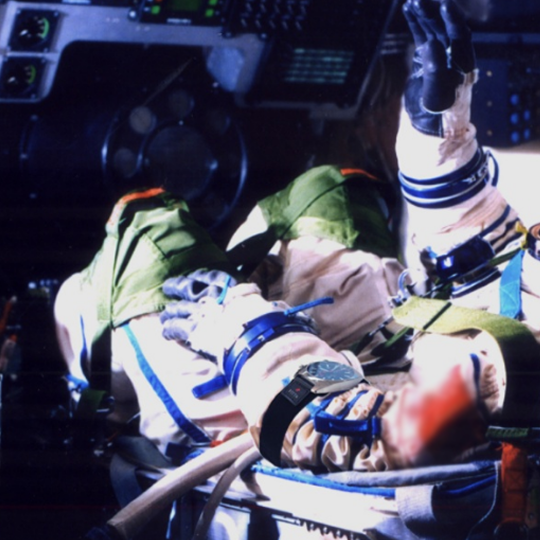
Our journey into space began in 2001, when FIYTA was selected through rigorous blind testing to develop a watch for China's crewed space program.
Two years later, in October 2003, our watch accompanied China's first astronaut on his 21-hour mission aboard Shenzhou V. Developed for use with his in-cabin spacesuit, it helped time suit leak checks before launch and landing.
2008

MISSION CONTROL
2008 | China's First Spacewalk
−80°C to +80°C
48,000 A/m
45-minute chronograph
7+1 hour warning
Red Dot Award 2010 · Musée international d'horlogerie
We spent three years developing the watch's multifunction mechanical chronograph movement in-house. A 45-minute chronograph counter was designed for spacewalk timing, while a "7+1" hour warning scale on the bezel helped the wearer monitor the time limit for activity outside the spacecraft.
To prepare the watch for this exposed environment, we addressed the challenges of extreme temperatures, pressure changes, magnetic interference and radiation throughout its development.
Testing covered temperatures from −80°C to +80°C, magnetic fields of 48,000 A/m, acceleration, shock and vibration, as well as repeated cycles of rapid depressurization and repressurization. The watch maintained accurate timekeeping throughout.
In March 2010, the Shenzhou VII spacesuit watch received a Red Dot Award for product design. That same year, it joined the collection of the Musée international d'horlogerie in Switzerland.
THE FUTURE OF FLIGHT
SZ-8
Docking with Tiangong-1
Shenzhou VIII's docking with Tiangong-1 helped lay the groundwork for longer stays in orbit. Our watches accompanied the astronauts who carried that journey forward.
SZ-9
First female astronaut
Shenzhou IX carried China's first female astronaut into space.
SZ-10
Live lesson from orbit
During Shenzhou X, the country's first live lesson from orbit brought space exploration into classrooms on Earth.
SZ-11
Longest crewed mission
Shenzhou XI went on to complete what was then China's longest crewed mission.
Today, our journey continues aboard China's space station. Our watches remain part of life in orbit, accompanying the astronauts whose daily work carries exploration forward.
2010
A journey to Mars begins long before launch. In 2010, an international crew entered an enclosed facility on Earth for Mars-500, a 520-day simulation of a mission to Mars and back.
From the outward voyage and a simulated Mars landing to the return home, the experiment explored how people could live and work together through prolonged isolation. Throughout the experiment, the Chinese participant wore one of our space watches. Our clocks also kept time in the control room and communal area, supporting the daily routines behind this preparation for future space travel.

COMMEMORATIVE DESIGN
We later created our Mars-500 watches to commemorate the project and carry its spirit of exploration into everyday life. Their angular, octagonal cases draw inspiration from the form of a Mars rover.
The meteorite dials tell a story that began long before the experiment. Their interlocking Widmanstätten patterns formed as iron-nickel metal cooled slowly over millions of years, long before the material reached Earth. Cutting, polishing and acid etching reveal this natural crystalline structure, giving each dial a pattern of its own.
A LIFELONG QUEST
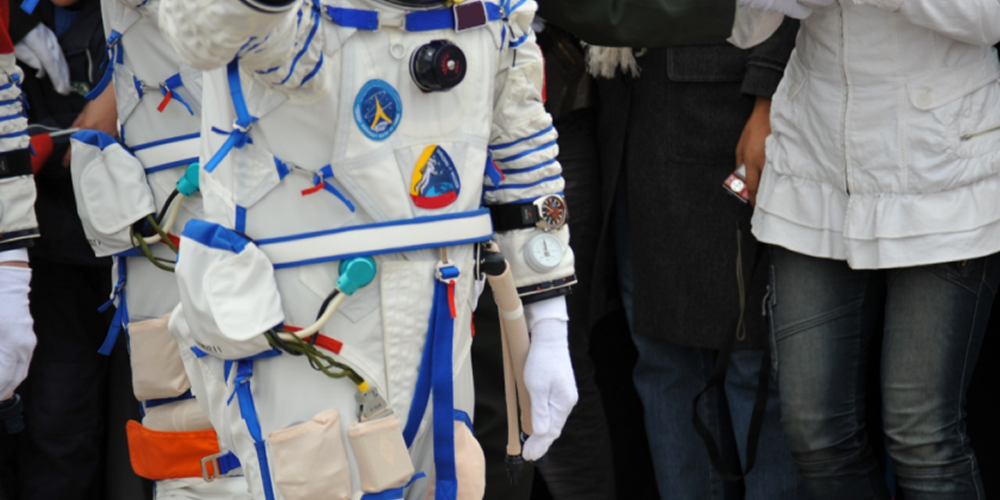
Long before we reached for the stars, we wondered what lay beyond the horizon. That curiosity is still with us, in the places we seek, the questions we ask and the paths we choose. Our watches have accompanied astronauts into space. We carry that same spirit of exploration into the timepieces we create for the journeys you have yet to begin.

